Skip to content
New Grad / Campus Recruiting

Student Resume Builder: Fill One Page Without a Big-Name Internship

Recruiters spend 6–10 seconds on a campus resume, so the goal is not more experience—it is denser evidence for this one role. This page breaks down the section order, how to write coursework as project experience, and the mistakes that cost you interviews.

What This Page Covers

A fixed one-page section order

Education first, projects and internships ranked by relevance, campus activities and skills at the bottom—nothing for the recruiter to hunt for.

Coursework that reads like experience

Capstones, competitions, lab work, and open-source contributions become project bullets using context → your work → result.

Keywords aligned to the job post

Place the tools and domain terms from the posting inside project bullets and the skills block—never paste the posting itself.

Free, no sign-up, no watermark

Export a vector PDF straight from the browser that both applicant tracking systems and human readers can parse.

A Campus Resume Answers One Question: Why You

Most student resumes do not lack experience—they dilute the relevant parts with filler. A screener only checks three things: are you in this field, have you done something similar, and can you explain it clearly.

Sending one identical file to twenty companies is the usual mistake. Keep a master resume, then create two or three variants for different role families, adjusting only the section order, project ranking, and skills block.

  • Strictly one page: education → projects / internships → campus leadership → skills and certificates
  • Three to four bullets per experience, each with an action, a context, and a result
  • Quantify wherever possible: people, percentages, time saved, ranking, budget, growth
  • Only list skills an interviewer could probe

Filling the Page Without an Internship

Capstone projects, thesis work, lab assignments, competitions, open-source contributions, technical write-ups, and student-organization output all count as project experience. What matters is your role and decisions, not a restatement of the assignment brief.

Use a repeatable three-part sentence: context (what problem existed) → your work (what you did and why) → result (a number or something verifiable). Three sentences are enough for a strong bullet.

  • Coursework: name the stack, the module you owned, and the final grade or deployment outcome
  • Competitions: state the format, team size, your share of the work, and the rank or round reached
  • Lab work: describe the research question, method, data scale, and conclusion or paper status
  • Campus activities: give the event scale, the resources you coordinated, and a measurable result

Three Mistakes That Cost You Interviews

First, a half-page objective statement full of adjectives. Second, sentences copied from the job posting that collapse under one follow-up question. Third, decorative layouts that break PDF text extraction so the parser cannot find your university or major.

The first two are content fixes. The third is structural: single column, standard font sizes, and real text for body copy—never images or text frames. All nine Lucky Resume templates output a clean text layer.

  • Delete unverifiable claims such as hard-working or detail-oriented
  • Never paste the job description; align keywords through your own results
  • After exporting, search the PDF for your university and major to confirm the text is selectable
How to Apply This in 4 Steps

  1. 01

    Pick a campus-appropriate template

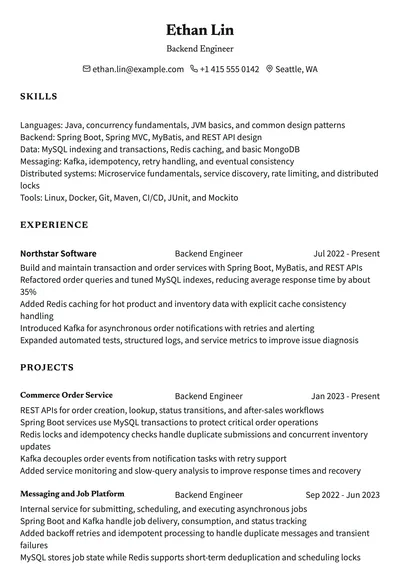
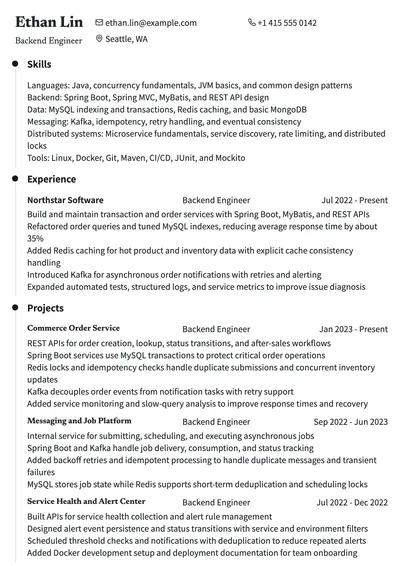
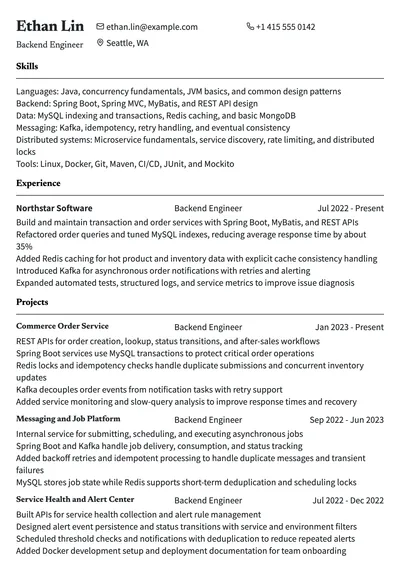
    Classic single-column fits almost every campus role; minimalist or timeline works if your experience is coherent and you want more whitespace.

  2. 02

    Fill in education

    School, degree, field, dates. Include GPA or rank when it is strong, and list only 3–5 role-relevant courses instead of your full transcript.

  3. 03

    Fill the page with projects

    Three to four bullets per project in the context → work → result format, each under a line and a half, strongest project first.

  4. 04

    Export and self-check

    Search the exported PDF for role keywords, confirm nothing spills onto page two, and verify the page reads end to end.

Templates to Start From

All 9 templates

Frequently Asked Questions

Will my resume look empty without an internship?

No—provided you write coursework, competitions, and lab work as project experience. Recruiters evaluate what you did, how you did it, and what changed; two solid projects with three or four quantified bullets each are stronger than one shallow internship.

How many pages should a student resume be?

One. Campus experience is limited, and a single page guarantees the reader finishes in ten seconds. Two pages only make sense for PhD candidates or unusually large output, and page one must stand alone.

Should I include my GPA?

Include it when you rank in the top 30% or hold a 3.5/4.0 or better, and state the scale. Otherwise spend the space on projects. If a posting explicitly asks for grades, a major-specific rank is often enough.

Should a campus resume include a photo?

Optional in mainland China, unnecessary elsewhere, and actively discouraged for remote or international roles. Lucky Resume lets you toggle the photo block, so one document can produce both versions.

Does listing Microsoft Office help?

Rarely. Only list tools an interviewer might probe; Office is assumed. Spend those lines on role-relevant skills such as SQL, Python, Figma, or analytics tooling.

Related Guides