Skip to content
Engineering

Developer Resume Builder: Stacks, Projects, and Measurable Impact

A technical resume gets read twice: first by a recruiter or parser matching keywords, then line by line by an engineer. This page explains the difference and gives project bullets you can adapt directly.

What This Page Covers

Two readers, two requirements

Keywords decide whether you enter the pipeline; trade-offs and constraints decide what gets discussed in the interview.

Five parts of a project bullet

Business context, your ownership, the technical choice and why, the hard part, and the outcome—skip one and expect a follow-up.

A stack that is grouped, not dumped

Languages, frameworks, storage, and infrastructure listed separately with honest proficiency levels.

A parseable text layer

No code or tables rendered as images, so exported PDFs keep searchable keywords for ATS and sourcing tools.

Round One Is Keywords, Round Two Is Depth

Round one is a recruiter or an ATS matching terms: languages, frameworks, middleware, cloud services, domain vocabulary. It takes seconds, so keywords belong in obvious places—the skills block and the first clause of each project bullet.

Round two is an engineer reading line by line. They want to know the scale of the systems you touched, the bottlenecks you hit, why you chose one approach over another, and what changed. Participants-in-a-project phrasing fails here.

  • Group the skills block: languages → frameworks → storage → tooling and infrastructure
  • Put the technology keyword in the first eight words of a bullet
  • Give every project at least one number: throughput, latency, cost, or coverage

Project Bullets That Carry Information

A high-signal project entry has five parts: business context and scale, the module you owned, the key technical choice and its reason, the hard part, and the measurable outcome. A bullet without an outcome reads as filler.

When there is no monitoring data, use verifiable substitutes: endpoint counts, load-test results, recovery time, review pass rate, or the share of the release cycle you removed. The number does not need to be impressive—it needs to survive questioning.

  • Weak: Worked on the order module using Spring Boot and MySQL.
  • Strong: Rebuilt the order lookup path with tiered caching and cursor pagination, cutting P99 from 820ms to 130ms across 3M daily calls.
  • Weak: Participated in frontend performance work.
  • Strong: Cut LCP from 3.4s to 1.6s with route-level splitting, lazy images, and font subsetting, lifting signup conversion 6%.

Where a Tech Stack Ends and Expertise Begins

Longer is not better. Twenty entries invite a random spot check you cannot pass. Use eight to twelve grouped items and put your two or three strongest first.

Expertise is a commitment: claim it and you should be able to discuss internals, edge cases, and production incidents. Most candidates are better served by proficient, reserving expert for the library you maintain or the runtime you have read.

  • Languages: TypeScript, Go, Java—with years of use or a representative project
  • Frameworks and middleware: React, Node.js, Spring Boot, gRPC, Kafka, Redis
  • Storage: MySQL sharding, Elasticsearch, object storage
  • Infrastructure: Docker, Kubernetes, CI/CD, cloud services
How to Apply This in 4 Steps

  1. 01

    Pick a technical layout

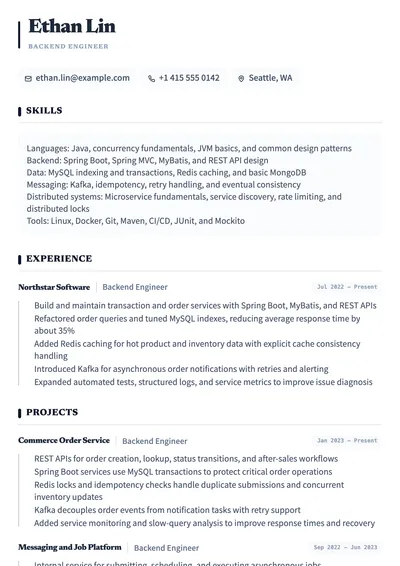
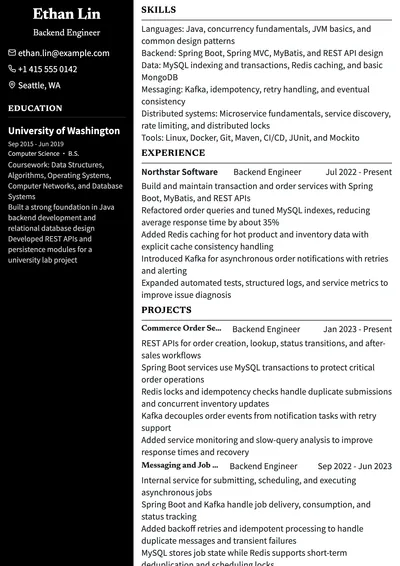
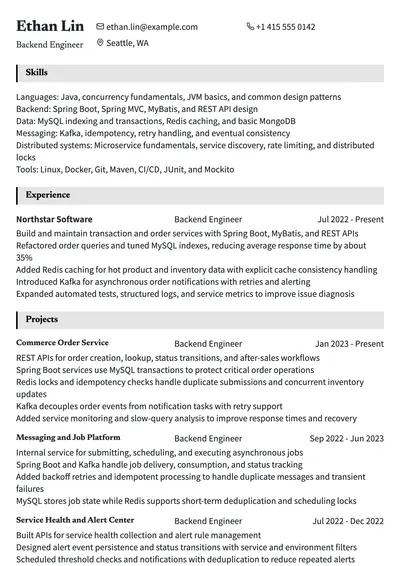
    A left-right split suits skill-heavy profiles, Swiss grid emphasizes typographic order, and a two-column layout fits hybrid roles.

  2. 02

    Write the skills block first

    Eight to twelve grouped items ordered by proficiency, with anything you only met in a tutorial removed.

  3. 03

    Rewrite each project

    Fill in context, ownership, choice, hard part, and outcome; every project needs at least one metric.

  4. 04

    Run an ATS self-check

    Search the exported PDF for your stack, confirm code and tables are real text, and check that page breaks do not split headings.

Templates to Start From

All 9 templates

Frequently Asked Questions

Should a developer resume link to GitHub?

Link repositories you actively maintain and can explain the design trade-offs of. Empty repos, forks with no commits, or tutorial clones hurt more than help—a reviewer closes the tab in two seconds.

One page or two for a technical resume?

One page up to about five years of experience. Senior, architect, or hybrid engineering-management roles can use two, but page one must stand alone with your stack, two strongest projects, and metrics.

Should I write expert?

Only if you can discuss internals, edge cases, and real incidents. Otherwise proficient or familiar is safer—claiming expert in Java invites questions about the memory model and GC tuning.

What if my project has no monitoring data?

Use verifiable substitutes: endpoint counts, load-test numbers, recovery time, review pass rate, release-cycle reduction, or automated test coverage. Small numbers are fine; invented ones are not.

How do frontend and backend resumes differ?

Frontend emphasizes performance (LCP, CLS, bundle size), interaction complexity, and build tooling. Backend emphasizes concurrency, data consistency, reliability, and cost. Both need quantified outcomes.

Related Guides